The persimmon crop seems a bit late this year. Hachiya, the type that must be soft to be enjoyed, is being harvested now. Most of them are used for making hoshigaki. If they are too small or too large we sell them fresh to our customers. Most customers want the already soft ones. I usually tell them that if they don't buy them today, when they come back these will be sold and there will be new hard ones on our table. We recommend leaving the hard hachiya on the counter at room temperature till it is soft and gelatinous. This may take a week or two. The internet recommends putting the unripe hachiya into a closed container with an apple or banana which will produce the ethylene gas to hasten ripening.
Hoshigaki production is in full swing. We are peeling at least 15 boxes a day, 5 days a week. We peel, hang them in pairs on string, balance the pairs of persimmons on sticks, put the sticks on racks in the sun. Then wait for the fruit to begin to ripen on the inside. When the skin is leather-like and the inside is getting soft, we begin to massage each one. Every few days we massage the fruit to break up any masses inside. After massaging we like to bring the hoshigaki indoors. The fruit is getting sweet and is a tempting treat for the critters. After 2 to 4 weeks much of the liquid has evaporated and the hoshigaki is becoming a concentrated bag of sweet persimmon pulp. Then the magic begins to happen. Somehow the sugars from the fruit begin to form a dusting of white sugar on the surface. With a little more drying the sugars coat the surface of the persimmon. Now we have Hoshigaki.
Fuyu persimmons are starting to come into the farm stand. They are more yellow and starting to get that orange glow. Fuyu are round and usually flattish. They can be eaten like an apple: hard, crisp, and sweet. Great for snacking and adding to salads. I hope to have a bountiful supply beginning in November.
The brown fleshed persimmons have been slowly ripening. A few come in and a few get sold. Brown fleshed persimmons are astringent unless pollinated. Back in April when the trees were in bloom, the bees were buzzing. If the flower was fully pollinated , seeds would form and give off ethylene gas to make the flesh brown and sweet. The problem arises when a flower is only partially pollinated and less than half of the seeds form. This fruit will be only partially sweet. It's always a risk. We recommend cutting the fruit and eating only the brown, sweet flesh.
Apples and pears are still an important part of our production. We are currently harvesting Reinette Simerenko and Fuji apples. Later will come Pink Lady and Granny Smith. Our last European pear is Comice. When the skin turns yellow it is ready to eat. It is sweet, soft, and very juicy. We have several Asian pears: Shinko, Olympic, and Yali. They are all crisp, juicy and sweet. I would say Shinko is the sweetest, Olympic the hardest, and Yali the juiciest.
HOURS:
Tues through Sat 10:00 am to 6 pm
Sunday 11:00 am to 5:00 pm
CLOSED ON MONDAYS
Here is what we have at the Farm Stand from Otow Orchard
Hoshigaki:
Currently sold out.
These are whole dried persimmons. They were hand massaged while they
dried over a period of four to eight weeks. Some are firm, others are
soft and moist. All are coated with naturally formed white persimmon
sugar. No sugar added and no preservatives used. Hoshigaki processed
in 2022 have sold out. We normally begin peeling persimmons in
October. The early hoshigaki may be available in November. You may
contact us for on-farm pick-up orders. (916) 791-1656 or email at otowochard@yahoo.com. For mail orders please use our mail order form . Mail order shipments do not usually begin until December.
Apples:
Fuji: Known for being sweet juicy and always crisp.
Reinete Simerenko: a green sweet-tart apple with great flavor. I call it a cider apple.
European Pears:
Comice : Large, juicy, sweet pear when ripe. Wait for the skin to turn yellow. Similar to a Bartlet pear.
Asian Pears: Shinko: Large round pear with brown skin. Very sweet, crisp, and juicy, a good keeper.
Olympic: Large, dark brown, round Asian pear. It has a good crunch and the flavor is intense. It is juicy and very sweet. Can be used for pies and cobblers.
Persimmons:
Hachiya:
Tall acorn-shaped persimmon. It is astringent until soft and
jelly-like. It becomes very sweet soft and delicate. Fresh eating right
out of its skin or often used for baking cookies and pudding. Used for making hoshigaki.
Fuyu: Apple type persimmon. Can be eaten hard and crisp. These are always sweet and a favorite among our customers and future customers. At this time of year they are hard and crisp. Later in the season or if held for a period of time they will become more orange-red and the flesh will become tender and sweeter. Used for fresh eating and in salads.
Maru, Chocolate, and Nagamaru: These are the brown fleshed persimmons. Back in April when the trees were in bloom, the bees were buzzing.
If the flower was fully pollinated , seeds would form and give off
ethylene gas to make the flesh brown and sweet. The problem arises
when a flower is only partially pollinated and less than half of the
seeds form. This fruit will be only partially sweet. It's always a
risk. We recommend cutting the fruit and eating only the brown, sweet
flesh. Some varieties will sweeten as they soften.
Jujube:
Jujube are often called Chinese dates, ber, or when dried they are
called red dates. We harvest when they are yellow and brown. Gradually
they become all brown and eventually shriveled. They are enjoyed at all
these stages. They are sweet and crisp like an apple but not as juicy.
An
easy snack but watch out for the seed. This little round fruit has long
been recognized by Chinese medicine as having many health benefits. It
contains minerals and antioxidants. Avoid if on anti-seizure or
anti-depressant medications. Limited supply.
Honey 🍯 from bees 🐝 at Otow Orchard.
Bee pollen from bees 🐝 at Otow Orchard.
⚘ Calendula Salve and Lip Balm: Wonderfully thick salve for healing dry skin, bug bites and scrapes.
Tomatoes: Just about finished. The tomatoes are small and not as flavorful as when we had intense heat and long days. This late in the season, sizes and quality are challenged. Limited supply.
Chili Peppers: Aji Amareto, Buena Mulata, Jalapenos, ---All limited supply.
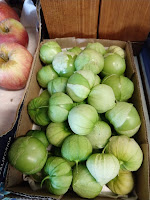
Tomatillos:
These look like small green tomatoes in a paper shell. They can be
cooked or eaten raw. You can add them to salads or make them into green
salsa.
Japanese Eggplant: These have a long shape with thin skin. It has tender flesh with delicate flavor and few seeds.Sweet Peppers: Green, yellow and purple varieties.
Okra: When we pay attention, we harvest tender pods.
Winter Squash:
Kabocha,
Red Kuri, Black Futsu: Known as a Japanese pumpkins. These varieties
have sweet, thick dry flesh. They can be steamed, baked, roasted, sauteed
or added to soups and stews.
Butternut
Squash: One of the most popular winter squashes because of its
generous flesh. The seeds are contained in the bulbous end and the neck
is all flesh. It has a sweet nutty flavor. Is can be roasted,
steamed, baked and chopped into soups, stews, casseroles and curries.
Flavor a can be savory or sweetened with syrup and butter.
Quince:
This fruit is firm and seldom eaten raw. It has a pleasing fragrance
which can be preserved by making sauce, jams, jelly, adding it to apple
dishes, and pairing it with pork. It is a great source for pectin.
Quince must be peeled, cored and cooked to make it softer. It is
famously used to make Quince sauce or Doulce de Membrillo, Quince candy.
Pomegranates: Sweet White Pomegranates
Here is what we have from other producers:
WoodRose Country Garden in Granite Bay, organic practices:
Eggplant, okra, beans, colorful bell peppers, potatoes, garlic and arugula.
Seasoning: basil, rosemary,
oregano, thyme, fresh garlic
Tomatoes: Tomatoes, and cherry tomatoes.
Winter squash: Pink Banana Squash,
Top O' the Hill Apiary in Granite Bay: Bees wax 🐝.
Sunnyslope Farm Conventional practices, Garanite Bay, CA: Fuji Apples.
La Bella Vito Farm
in Loomis is bringing us fresh🥚 eggs from pastured 🐔🐔chickens.
Production is low. As days get shorter the chickens go through molting.
This is the process of loosing old feathers and regrowing new
feathers. During this period, egg laying decreases and chickens
concentrate on storing nutrients for the next season. Kijani Farm
in Granite Bay, organic practices:
Sweet 100 cherry tomatoes
Kabocha, Japanese
winter squash (pumpkin). Butternut winter squash
Mihara Farm
conventional farming in Newcastle, CA: Kiwi, Chestnuts, Hachiya persimmons.
Stoney Point Farm, Organic certified, Loomis, CA: Hachiya persimmons.
Placer County Master Gardeners: 2024 Gardening Guide and Calendar. Provides helpful hints throughout your gardening year.


.jpg)

 Valencia: These are juicing oranges but most people just peel and eat like any other orange. They are sweet and very juicy.


.jpg)


.jpg)


.jpg)